

Etonnant cette nouvelle mise en doute du principe établi par Einstein comme quoi il existait UNE CONSTANTE, celle de la vitesse de la lumière.
Et oui, c’est la dernière hypothèse émise par le professeur Steven Weinberg à l'université Harvard : la vitesse de la lumière augmenterait... au fur et à mesure du temps !!!???
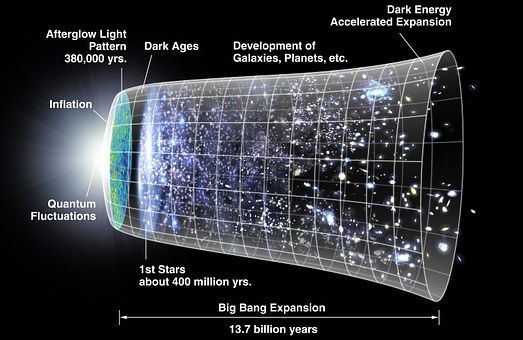
Conséquence ? A l’instant T = 0, à la création de l’univers, du début du fameux Big Bang, la vitesse de la lumière serait quasi nulle ! Et la naissance de notre univers ne daterait pas de 13,7 milliards d’années (dans l’hypothèse d’une vitesse de la lumière constante) mais serait repoussée à l’infini...
Et cette date butoir, ainsi que l’évaluation de la vitesse d’éloignement des astres en fonction de leurs distances permettrait de définir l’accélération de la lumière.
Pour mieux comprendre, imaginez que notre univers soit la surface d’une sphère qui gonflerait au cours du temps, sauf que cette sphère aurait 4 dimensions dont le rayon est le temps et la surface, notre espace classique, d’où l’extension : et oui, le temps passe !... On comprend alors mieux la notion d’accélération de l’expansion de l’univers : sur la surface de cette bulle qui grossit, l’éloignement de 2 points s’accélère. Cf. loi de Hubble. Cela signifie, par contre, que la lumière mettait autant de temps, peu après le Big Bang, pour parcourir la faible distance entre 2 points, que de nos jours où cette distance est devenue très grande du simple fait de l’expansion de l’univers.
Mieux : la présence de matière modifierait cette vitesse de la lumière – bon, ça on le savait – mais dans le sens où la matière représenterait des lieux où la vitesse d’expansion de l’univers n’est pas la même. Le temps prenant du retard…
Ainsi, l’univers est statique, d’une certaine manière, si l’on tient compte que c’est la vitesse de la lumière qui « varie » : Einstein, serait content !
RENE JUSVEL
ASTROPHYSICS - The bubble universe all the time
Amazing this new questioning of the principle established by Einstein that there was ONE CONSTANT, that of the speed of light.
And yes, this is the last hypothesis made by Professor Steven Weinberg at Harvard University: the speed of light would increase ... as time goes by !!!
Result ? At the moment T = 0, at the creation of the universe, the beginning of the famous Big Bang, the speed of light would be almost zero! And the birth of our universe would not date back 13.7 billion years (assuming a constant speed of light) but would be pushed back to infinity ...
And this deadline, as well as the evaluation of the speed of removal of the stars according to their distances would define the acceleration of the light.
To better understand, imagine that our universe is the surface of a sphere that would swell over time, except that this sphere would have 4 dimensions whose radius is the time and the surface, our classical space, hence the extension: and yes, time passes! ... We understand better then the notion of acceleration of the expansion of the universe: on the surface of this bubble that grows, the distance of 2 points accelerates. See Hubble Law. This means, on the other hand, that the light took so much time, shortly after the Big Bang, to cover the short distance between two points, than today when this distance has become very large simply because of the expansion of the universe.
Better: the presence of matter would change this speed of light - well, we knew it - but in the sense that matter would represent places where the speed of expansion of the universe is not the same. Time falling behind ...
Thus, the universe is static, in a way, if we take into account that it is the speed of light that "varies": Einstein, would be happy!


