

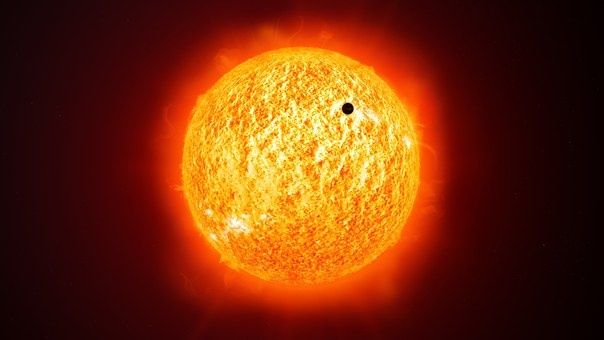
Vous avez sans doute remarqué (ou pas, si vous avez d’autres priorités) que quasiment tout tourne dans notre univers : planètes, galaxies,… mais parfois pas !?
Jusqu’à présent, on pensait que ça devait probablement influer sur la rotation, dans le même sens, des objets avoisinants : exemple, le soleil et ses planètes, et sur un aplatissement de l’astre en rotation par force centrifuge.
Sauf que l’influence est tout autre. En fait, et selon le Laboratoire de Physique Théorique de l’Ecole Normale Supérieure, cela conditionnerait l’attraction gravitationnelle !
Comment ça ? Normalement, la force de gravitation devrait suivre l’équation de Newton, voire matée de Relativité. Mais ceci ne serait vrai que pour un objet sans rotation intrinsèque.
En cas de rotation sur lui-même, le champ de gravitation serait dégressif, certes, mais avec une amplitude sinusoïdale dont la longueur d’onde augmenterait avec la distance.
Cela rejoint d’autres hypothèses sur la répartition discrète des planétaire, que nous avions déjà abordées… et sur d’autres hypothèses que nous aborderons bientôt.
On n’est pas loin de la notion de spin, vous savez, cette caractéristique des particules équivalente à une rotation…
RENE JUSVEL
PHYSICAL - New on the rotation
You have probably noticed (or not, if you have other priorities) that almost everything turns in our universe: planets, galaxies, ... but sometimes not!
Until now, it was thought that this probably influenced the rotation, in the same direction, of neighboring objects: for example, the sun and its planets, and a flattening of the star rotated by centrifugal force.
Except that the influence is quite different. In fact, and according to the Laboratory of Theoretical Physics of the Ecole Normale Supérieure, this would condition the gravitational attraction!
What do you mean ? Normally, the gravitational force should follow Newton's equation, or even Matter of Relativity. But this would only be true for an object without intrinsic rotation.
In case of rotation on itself, the field of gravitation would be degressive, certainly, but with a sinusoidal amplitude whose wavelength would increase with the distance.
This ties in with other hypotheses about the discrete distribution of the planet, which we had already discussed ... and other hypotheses that we will discuss soon.
We are not far from the notion of spin, you know, this characteristic of particles equivalent to a rotation ...


